Green Kitchen: Why Eat Local?

Green Kitchen is a bi-weekly column about nutritious, inexpensive, and ethical food and cooking. It's penned by the lovely Jaime Green.

Do you feel like all you hear these days is "eat local"? Wondering what all the hype is about? What's the point? Isn't that just a fad for hipsters and yuppies who don't get enough snooty karma from their NPR totes?

Though it won’t cure the common cold or reverse the mortgage meltdown, local food is pretty darn great, and not just because it’s traveled a shorter distance in a gas-guzzling truck or plane. Food from nearby is healthier and tastier, not to mention good for the planet, good for your community, and good for your spirit.

Here’s why.

LOCAL FOOD IS GOOD FOR THE ENVIRONMENT

Local food has a smaller carbon footprint. Flying bananas in from South America uses fuel for the plane ride AND power for cooling and storing mechanisms. Food from your ‘hood (or nearby) puts much less CO2 into the air with its transport.

Keep in mind, not all local food is carbon-light. Wintertime greenhouse tomatoes may come from the farm down the street, but the power to heat their environments is not negligible. Still, if you stick to local and seasonal food, you’re golden.

Patronizing nearby farms also supports green, open spaces in your area. Farms are susceptible to commercial development and exurb spread. If you help keep them solvent, you ensure your region hangs on to those lovely spreads of farmland and pasture.

Local farms tend to be smaller farms, as well. Big, national suppliers will farm massive tracts of monoculture: acres of soybeans or corn, which isn’t particularly good for the environment or the national waistline. They often use heavy pesticides and genetically-modified seeds. Smaller farms, on the other hand, tend to be much more diverse, and the best ones integrate their production in a symbiosis of fertilization and need, keeping the soil super-healthy and producing awesomer produce and animals. When animals are involved, it means a better life for them before they become dinner, too.

LOCAL FOOD IS GOOD FOR YOUR COMMUNITY
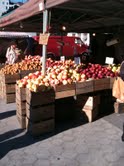
Buying your food from local producers also supports your local economy. Greenmarket farmers take home about 90 cents of each dollar. With supermarket produce, after the marketing, transport, and distributors, the farmer’s getting more like 21 cents. Part of the reason: government farm subsidies are heavily weighted towards grain and meat production.

Buying local also gives you a personal connection to your food. I know that my eggs come from near Ithaca, and my apples a few towns over upstate, and I get to hand my money right to the farmers that raised them. I guess at the supermarket I’m shopping alongside my neighbors, too, but it feels more personal, and features more smiles, when we’re doing it outside, in the sun.

LOCAL FOOD IS GOOD FOR YOU!

Local food is better for you. It's way fresher than what’s transported across the globe to your mega mart. Supermarket produce is often picked a week before it’s ripe, and has to do its final ripening in transport. Local produce is often picked the day you take it home. Nutrients are preserved, and the flavor is often more prominent. Like, amazingly so.

Local food is often, hothouse tomatoes aside, seasonal. Anyone who’s sampled a strawberry in January knows that food in its prime season just tastes better. And, bonus: seasonal food is super-cheap! Right now my supermarket’s red peppers are $4.99 a pound. In August the greenmarket has that down to $1.99. The seasonal price drop happens in grocery stores, too, but it’s way more dramatic at the farmers market. Plus, the apples taste more like apples, and the greens are bright and still have a little dirt on them from when they were picked that morning.

Eating local and seasonal also supports variety in your diet and the food that farmers grow. This happens in two ways: first, when you commit to eating local, you get pushed, deliciously, outside your veggie comfort zone. If you’re used to string beans and zucchini year-round, a local meal in October can broaden your tastes to Brussels sprouts, kale, and cauliflower. (I think this connection with the seasons is good for your soul, too. Especially in the city, it's good to keep in touch with how nature goes.)

The second kind of variety: Local farms, because they’re not beholden to corporate supermarket beauty standards, are also able to sustain uglier, weirder breeds of plants. My supermarket usually has three or four varieties of apples; the greenmarket has at least twelve. Those heirloom tomatoes may be super-unattractive, but they’re also super delicious.

The farmer’s presence at the greenmarket bolsters your sense of community, but also gives you a valuable resource that’s absent from all but the awesomest supermarkets. You can ask, “Hey, what’s the best way to store these carrots so they keep as long as possible?” and also, “What do the eggs who laid these eggs eat? “How much to they get to frolick outside?” Sure, I could share my enthusiasm with the supermarket stock clerk, but I’d rather gush to the person who grew it himself.

* * *

There are ways beyond the farmers market to eat well and cheaply while being good to the planet, and I’ll get into some of those next time. But what do you think, readers? Do you shop at a farmers market or subscribe to a CSA? Do you get local food another way? Why or why not?

Resources:
“If buying locally isn’t the answer, what is?” Grist.org
“10 Reasons to Eat Local” Eat Local Challenge
“Why Eat Locally?” Treahugger
Foodroutes.org
Local Harvest

~~~

If you like this post, you may also like:

Ask the Internet: I Can’t Believe This Food Product Exists

Today, our Ask the Internet question is inspired by sheer astonishment.

Q: Yesterday on Twitter, Mark Bittman linked to an article about, “a novel tobacco product that some critics say too closely resembles Tic Tac breath mints,” made (natch) by Camel. He was justifiably concerned they would addict children.

Tweeter retroklahoma then discovered that CANDY CIGARETTES ARE STILL AROUND. Which … what? How? In America? IN 2010?!?! Ack.

So, I was wondering: what food’s very existence shocks you the most? Why? Is it too old-fashioned? Is it obviously bad for everyone who would consume it? Is it inexplicable using the rules of physics and/or nature?

A: Yeah. Candy cigarettes. Can you believe it? Even in the '80s, we knew that was some damaging badness. Is there a food product that elicits the same reaction from you? The comment section is open, folks.

Want to ask the interweb a question? Post one in the comment section, or write to Cheaphealthygood@gmail.com. Then, tune in next Tuesday for an answer/several answers from the good people of the World Wide Net.

Crustless Spinach Mushroom Quiche: Une Recipe Pour le Peuple

Today on Serious Eats: a one-two punch of Stir-Fried Lettuce (fuh real) and Sauteed Cabbage. Both much tastier than you might think.

Also: you asked, we’re answering. Starting today on Cheap Healthy Good, we’re including protein in our calculations. Enjoy!

When you imagine a prototypical quiche eater, what does the person look like? Is it:
  1. A beret-donning, baguette-loving Frenchman, alternating sips of expensive Sauvignon Blanc with nibbles of the delicate egg creation.
  2. A slim, sleek, Parisian fashion editor, who chews diminutive forkfuls between her morning cigarettes and coffee.
  3. A mustache-twirling, toque-fluffing, world-class chef, bent on achieving the perfect egg-to-cheese ratio.
  4. A mime.
  5. None of these above, though this obsession with French stereotypes is simultaneously mystifying and sexy.
I always imagined quiche to be the provenance of the upper class. Though consisting mainly of eggs, cheese and crust, it seemed an impossibly complicated dish, served by socialites whose champagne tastes were rivaled only by the fussiness of their breakfasts. And also the French.

The truth, however, is this: Quiche is for the people.

It is not, as I believed, exclusive to Donald Trump types. No indeed. Quiche is a blue-collar, working person’s kind of meal. Hardy and chock full of frommage, it’s a simple breakfast (Or lunch! Or dinner!) that’ll carry you clear through the morning. When you leave the crust part out, it’s even pretty healthy. (The first person that asks, “Isn’t it technically a frittata?” gets a punch in la tete.)

This quiche is adapted from All Recipes, and it combines the sheer health quotient of spinach with the delightful indulgence of sharp cheddar cheese. It’s fairly easy to whip up, and super satisfying to serve: “Honey, we’re having quiche today! Yes, quiche. No, no one is coming over. No, we didn’t win the lottery. Ack. I don’t know. Stop asking questions.”

A few notes, should you decide to take this on yourself:

1) Hand-grated cheese is almost always cheaper and better tasting than pre-grated. There are no annoying de-caking additives, is why. Try to shred your own block o’ cheddar here if you can.

2) If I did this again, I’d change the mushroom/spinach ratio slightly to include more of the former and a little less of the latter. But hey: whatever floats your boat. Ham would be smashing in here, if you’re up for giving it a try.

3) Thanks to Food, Inc. and a combination of other exciting neurosis, Husband-Elect and I permanently switched to Certified Humanely Raised eggs. (Note: It’s one of the only labels that really matters.) They are WAY BETTER than regular supermarket eggs, but also pricier. Whatever. It’s worth it, yo. The yolks are like, neon orange, and much more substantial. Cross over if you can. (Yes … that’s it … come to our side … use the Force, Luke.)

4) This isn’t a standalone dish, and should be served with some kind of side. Mayhaps une salade? Ou un croissant? This might give you some ideas:


In the meantime, enjoy, mes amis. Rappelez-vous: quiche est pour le peuple. (Literally: Rappel your quiche and pour it purple. I think.)

~~~
If you like this recipe, you may also delight in:
~~~

Crustless Spinach Quiche
Serves 6.
Adapted from All Recipes.


1 tablespoon olive oil
1 medium onion, chopped
4 ounces button mushrooms, sliced
1 10-ounce package frozen spinach, cooked
2 extra large eggs
5 extra large egg whites
1-1/2 cups 2% cheddar cheese, grated
1/2 teaspoon kosher salt (or more if desired)
1/4 teaspoon freshly ground black pepper (or more if desired)
A few shakes cayenne pepper (optional)

1) Preheat oven to 350°F. Coat a 9-inch pie pan with cooking spray.

2) In a large nonstick skillet, heat oil over medium-high heat. Add onions and mushrooms. Saute 5 or 6 minutes, until onions start to soften and ‘shrooms are a little browned.

3) Add spinach. Spread around and cook until most of the moisture is evaporated, stirring occasionally. This took me about 6 minutes, but your mileage may vary.

4) When finished, pour spinach mixture on to a plate. Spread out and let cool for a few minutes. (You’re doing this so it won’t cook the eggs prematurely when they're combined.)

5) Meanwhile, combine eggs and egg whites in a large bowl. Beat lightly. Add cheese, salt, pepper, and cayenne if using. Stir. Add spinach mixture and stir quickly to blend. Quickly pour into pie pan and shake a little to spread out.

6) Bake about 30 minutes. Remove from oven. Let cool 10 minutes. Serve.

Approximate Calories, Fat, Fiber, Protein, and Price Per Serving
184 calories, 10.3 g fat, 1 g fiber, 15 g protein, $0.91

Calculations
1 tablespoon olive oil: 119 calories, 13.5 g fat, 0 g fiber, 0 g protein, $0.15
1 medium onion: 46 calories, 0.1 g fat, 1.5 g fiber, 1 g protein, $0.25
4 ounces mushrooms: 25 calories, 0.3 g fat, 1.1 g fiber, 3.5 g protein, $0.90
1 10-oz pkg frozen spinach: 103 calories, 0 g fat, 3.4 g fiber, 6.8 g protein, $0.50
2 extra large eggs: 171 calories, 11.5 g fat, 0 g fiber, 14.6 g protein, $0.62
5 extra large egg whites: 100 calories, 0.4 g fat, 0 g fiber, 21 g protein, $1.54
1-1/2 cups 2% cheddar cheese: 540 calories, 36 g fat, 0 g fiber, 42 g protein, $1.50
1/2 teaspoon kosher salt: negligible calories, fat, fiber, protein, $0.01
1/4 teaspoon black pepper: negligible calories, fat, fiber, protein, $0.01
TOTAL: 1104 calories, 61.8 g fat, 6 g fiber, 88.9 g protein, $5.48
PER SERVING (TOTAL/6): 184 calories, 10.3 g fat, 1 g fiber, 15 g protein, $0.91

Save 95% on Groceries, a.k.a. Why You Should Shop at Ethnic Markets

Hey folks! We're trying something new for weekends: posting an older piece from the CHG archives. This one originally appeared in October 2007. Hope you dig it.

This past weekend, I paid $0.50 for a baggie of cardamom that was selling for $10.49 the next block over. The big difference between the two stores? The $0.50 folks ran an ethnic market. The $10.49 folks ran an upscale grocery store.

Six years ago, I lived in a neighborhood with two major supermarkets, both of which sold produce for above-average prices. Located 15 blocks south was a Korean-owned fruit and vegetable stand. The tomatoes, oranges, and garlic there went for half the cost of the local Key Food.

Earlier this year, a few friends needed 70 goodie bags for a promotional party. They cost about $0.34 a piece at the big-box supply store on 14th St. in Manhattan. Chinese food containers, which looked better and held more candy, went for $0.25 at Pearl River Mart in Chinatown.

It’s taken me a few years, but after Saturday’s cardamom adventure, I think I finally learned the moral of these stories: when in food-purchasing doubt, go ethnic. Whether you’re shopping for spices, produce, or supplies, those independent, family-run marts are fantastic alternatives to mega-stores. The prices are usually competitive (if not significantly lower), and the diversity of options, unbeatable. But it doesn’t end there. (Oh no – it doesn’t.) There are a bazillion other reasons why Kim’s Seafood beats out Food Lion any day of the week.

Shopping at ethic markets…

Encourages experimentation. Diversifying your diet is hard, especially when you’re locked into losing weight. If you’re looking to lift yourself from the meat-and-two-veg rut, ethnic markets are the place to be. Imagine aisle upon aisle stacked with soba noodles, yuca, and saag paneer. Even if you don’t know what any of those things are – trust me, they rule. And the store they came from can introduce your palate to all kinds of crazy flavors you didn’t even know existed.

Promotes diversity. Hey man, our families were all immigrants somewhere along the line. And according the Census Bureau, 40% of the U.S. population will be of ethnic origin by 2010. So, think of the ethnic market as a fabulous opportunity to introduce yourself to a new culture, but also, to meld that culture harmoniously into your own. While you’re perusing the shelves, take the time to speak to the proprietor or other customers. Odds are, everybody will learn something.

Reconnects you to your own culture. Are you a lapsed Swede? A part-German who’s completely ignorant of her background? A quarter-Brit with no discernible knowledge of her family’s cuisine? I am. Checking out ethnic markets gives me a good idea of what my grandparents and great-grandparents ate when they were still strolling the streets of Dublin. (Hint: potatoes.)

Helps small businesses. According to the Washington Post, family-owned ethnic grocers are losing ground as big-box supermarkets hone in on Asian, Hispanic, and African foods. Quite a few shops are even shutting their doors, and the operators’ expertise is being lost along with their leases. By buying from the ethnic market, you’re ensuring the preservation of your area, supporting a local family, and keeping that culinary knowledge alive in your community.

Ensures prepared foods are more authentic. Have you ever had sushi from CostCo? It’s excruciatingly bad. So is eggplant parmesan from Pathmark, and a burrito from Waldbaums. Oftentimes, ethnic markets will have a glass display case full of prepared foods. Try ‘em. See if you like ‘em. If you do, take some home, or try to prepare light versions on your own.

Is oh-so-hip. Eating well and frugally hasn’t always been synonymous with coolness, but it’s getting there, with lots of help from ethnic markets. According to almost every single craze-tracking source out there (magazines, websites, journals, etc.) ethnic food is consistently one of the fastest-growing trends in home cooking. (Cooking Light in particular is a big fan of meal diversification.) Buy a Ming Tsai cookbook, pick up a wok, and get with the times, man.

Makes for creative and creative gifts. Oftentimes, ethnic markets are chock-frigging-full of gorgeous tableware and cooking equipment, not to mention shelf after shelf of exotic mixes, spices, and specialty foods. And? It’s mostly pretty inexpensive. Next time you’re searching for a truly unique, out-there gift, grab a cart and go.

Can be a great bonding experience. Ethnic markets aren’t just grocery stores – they’re opportunities to spend quality time with loved ones. Teaching your kid about daikon? Learning from Grandma about what she ate in the olden days? Group-shopping for a Sunday dinner? Head for your local Indian grocer, which is a museum, a school, a library, and a food store wrapped all in one.

And last but not least (since it’s worth mentioning again), shopping at ethnic markets …

SAVES CASH. Ay-chi-wa-wa, yes. Though this might not extend to all markets/foods, you can conserve massive amounts of cash buying produce, spices, and certain ethnic specialties at the Korean place down the block, rather than the Megamart uptown. Cardamom! $0.50! Not kidding! Go!

If you’re interested in reading more about the glory of ethnic markets, these two faboo resources can help get you started: